The Third Story
How to end an affair: a grief the world won't give you, and a private place where your pain is allowed to be real.
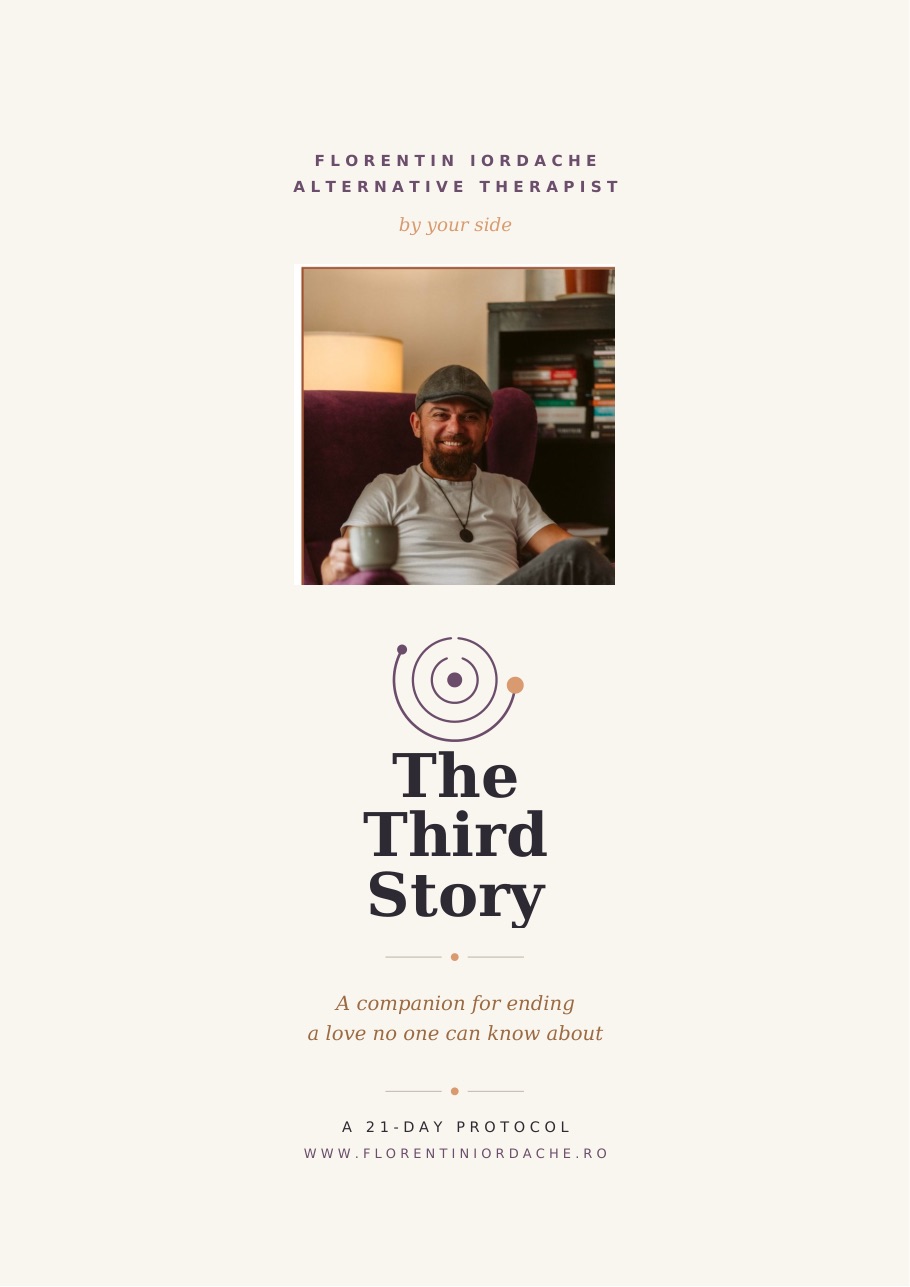
- For the days after you decide to end a hidden relationship and have no one to tell.
- 21 days of short daily practices, about 10–15 minutes each, plus a longer anchor at the end of each week.
- Helps you build no contact, tell shame apart from guilt, and write what you couldn't say to anyone.
You might recognize this
- You might recognize this: you carry a pain that no one around you counts as a loss.
- You act fine on the outside while, inside, you are grieving.
- You have nowhere and no one to tell what you lost.
- The relationship had no anniversaries, no photos on the wall, no seat at family dinners, and now it can't be mourned out loud.
What can change
Over 21 days, little by little, you can begin to:
- Recognize your pain as legitimate, not as something to be ashamed of.
- Build no contact and stop the bleeding.
- Tell shame apart from guilt, and write what you couldn't say to anyone.
- Settle back into your own life and close with a ritual.
What's inside
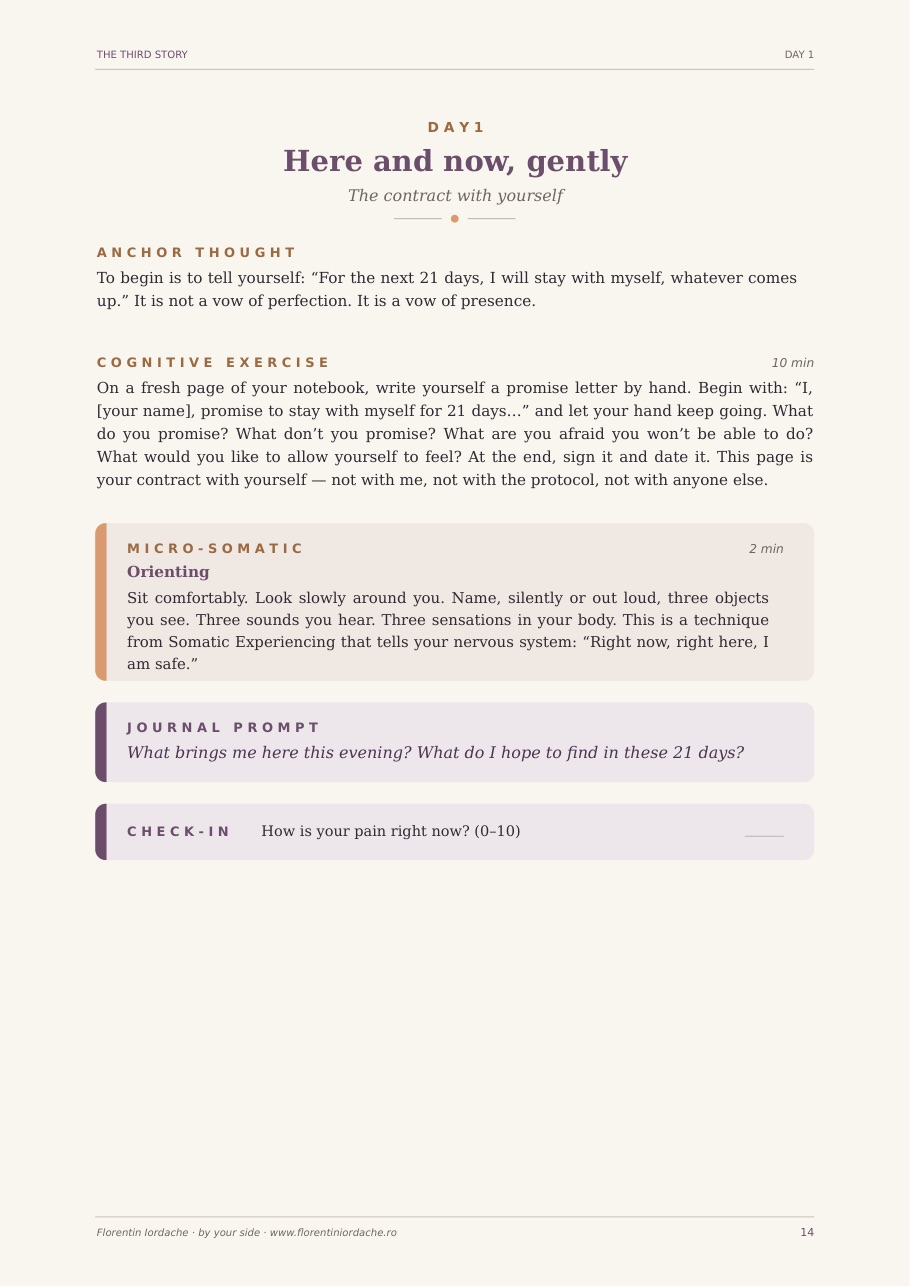
Three weeks, three movements. Week one, Stabilization: we stop the bleeding, learn to breathe, and build no contact. Week two, Settling: you look gently at what was, tell shame apart from guilt, and write. Week three, Reorientation: you settle back into your own life, understand which needs were activated, and close with a ritual. Each day has an anchor thought, a cognitive exercise, a micro-somatic practice, a journal prompt and a check-in where you rate your pain from 0 to 10. Days 7, 14 and 21 are weekend anchors of about an hour. It draws on work on disenfranchised grief (Kenneth Doka), ambiguous loss (Pauline Boss), expressive writing (James Pennebaker) and self-compassion (Kristin Neff).
This is not for you if
- If you are in an abusive or violent relationship, or having thoughts of harming yourself: please get help first. This workbook can wait.
- If you're looking for someone to decide for you whether to end it. This protocol is for after you've decided.
- If you expect the pain to be gone in three weeks. Grief keeps its own calendar.
- If you want a replacement for therapy or medical care.
About Florentin
Florentin Iordache is one of Romania's best-known voices on relationships and infidelity — a regular guest on national television and on podcasts, and the host of his own shows about couples, betrayal and the patterns we repeat in love. He is an alternative therapist in Bucharest who works with individuals and couples; he is not a psychologist. in his work, the same thing kept happening. A real insight in one conversation — and then six days alone with it. Between one honest conversation and the next, the old pattern keeps working in your place; it doesn't take breaks. The protocols are what he wrote for those days in between: a few minutes a day, written in advance, so you don't wake up asking “and now what do I do with this?” They don't replace a person beside you. They keep you company until then.
Questions
Is this therapy?
No. This is not therapy or psychological counseling. It is an educational, self-guided practice, and it does not replace working with a licensed professional.
Will I be "over it" at the end?
Grief doesn't work that way. What you'll have instead is a framework, words for what you're living through, and tools you keep.
Do I need anyone else?
No. It's written for one person, privately.
How long each day? What if I miss a day?
About 10–15 minutes. If you miss a day, pick up where you left off. The PDF is yours to keep.
What shows on my bank statement?
Your bank statement shows the seller's name, not the title of the protocol.
Can I get a refund?
Yes. Request a full refund within 48 hours of purchase using the refund form at /secret-lovers/refund.
If you are in danger or thinking of harming yourself, contact your local emergency number or find a free, confidential helpline at findahelpline.com.
If you're afraid of your partner, see nomore.org/global-directory.
Florentin Iordache is an alternative therapist in Bucharest. The protocols are educational and experiential self-help material. They are not therapy or psychological counseling, not a diagnosis or medical treatment, and they don't replace professional care. Payments are processed securely by Stripe. Terms (Romanian) · Privacy (Romanian) · Refund request · contact@florentiniordache.ro